


Phone:
+86-13456733297


Views: 0 Author: HengYi Packaging Technical Team Publish Time: 2026-08-24 Origin: HengYi Packaging Factory Records


A PE bag can be described as “0.04 mm thick” and still lead to two very different quotations. The reason is simple: one supplier may mean the thickness of one film wall, while another may mean the combined thickness of the two walls in a lay-flat bag. A clear specification should always state single-side thickness.
Single-side thickness is the thickness of one layer of polyethylene film. An open-top flat bag has a front wall and a back wall. If each wall is 0.04 mm, the combined two-wall stack is approximately 0.08 mm when the empty bag is laid flat.
Example: 0.04 mm single-side thickness = 40 microns per wall. The two walls together are approximately 80 microns, before allowing for measurement pressure, local variation and the sealed area.
For international RFQs, we recommend writing the unit in both millimetres and microns. In some Chinese factory conversations, “1 si” is used informally for about 0.01 mm, or 10 microns. Using mm and microns in the purchase specification removes this language risk.
Single-side thickness | Microns per wall | Approx. two-wall stack |
|---|---|---|
0.008 mm | 8 μm | 0.016 mm |
0.020 mm | 20 μm | 0.040 mm |
0.040 mm | 40 μm | 0.080 mm |
0.080 mm | 80 μm | 0.160 mm |
0.100 mm | 100 μm | 0.200 mm |
0.200 mm | 200 μm | 0.400 mm |
HengYi can produce PE bags and film from 0.008 mm to 0.20 mm single-side thickness. The right value depends on the bag dimensions, load weight, product edges, puncture risk, handling method and whether the bag will be reused.
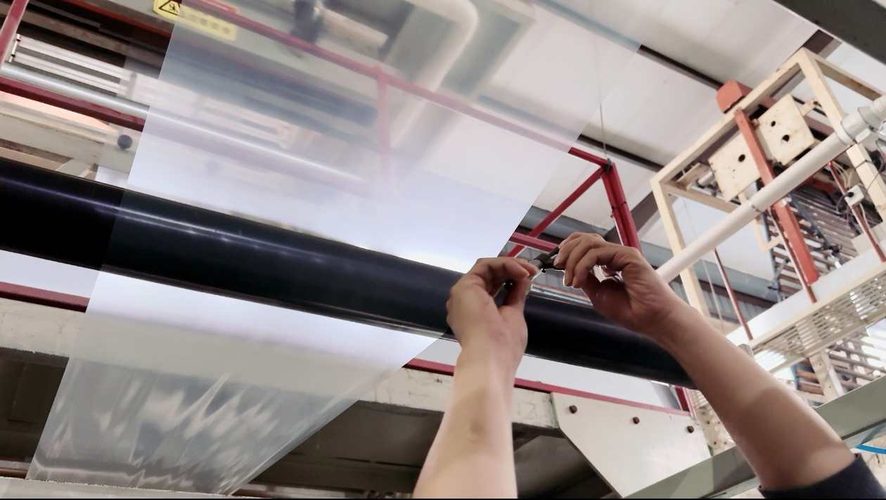
A production operator checks the film with a micrometer during blown-film production.
A small bag for lightweight components and a two-metre-wide liner should not be selected from thickness alone. A wider or longer bag places more stress on the film and seals. Sharp metal corners, frozen products, repeated opening and warehouse handling can also require a stronger material formulation or a thicker film.
The bag structure matters too. A side gusset increases usable volume, while a zipper or slider adds a closure function. These features change the stress distribution and the conversion process. Buyers comparing a flat open PE bag, a side-gusset PE bag and a zipper bag should therefore compare the complete specification, not only one thickness number.
Our process begins with incoming-resin inspection. During film blowing, operators check film thickness and width. During bag making, the bag size and seal are checked, followed by outgoing sampling before shipment. Our normal control targets are ±3% for thickness and ±1 mm for bag dimensions.
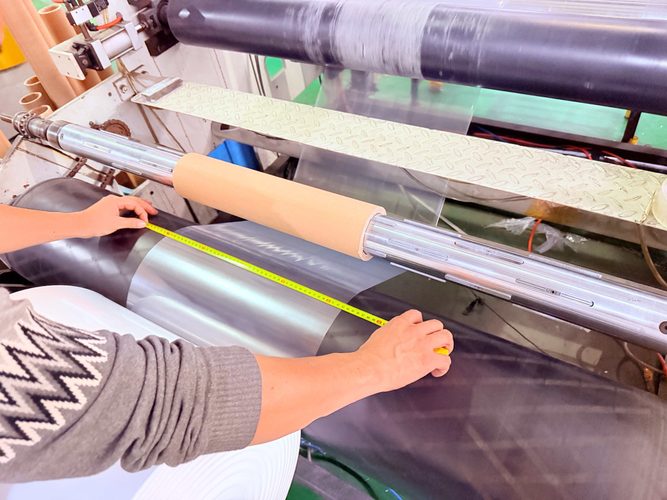
Film width is checked on the production line before bag conversion.
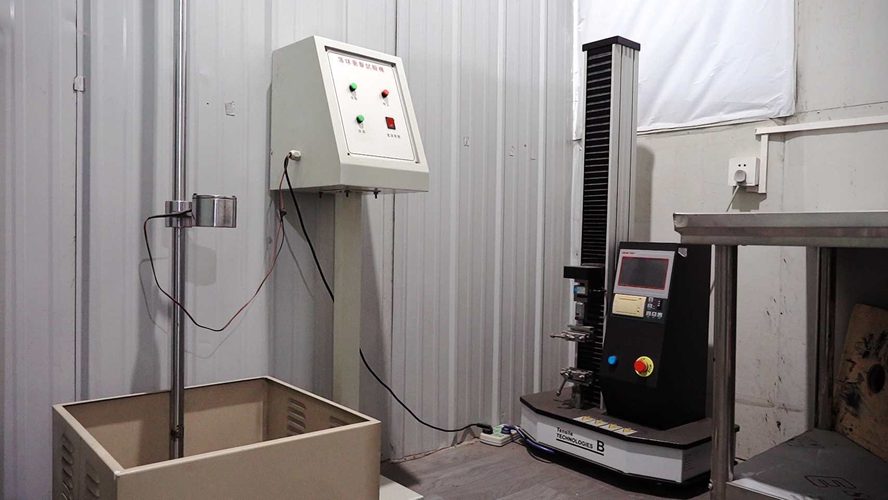
Testing equipment used to evaluate film and seal performance for production checks.
To receive a useful quotation, send the following information:
Bag width × length, with gusset size if required
Single-side thickness in mm or microns
LDPE, HDPE or another preferred PE grade
Contents, packed weight and any sharp edges
Transparent, coloured, frosted or light-blocking appearance
Printing colours, artwork and expected order quantity
Seal, zipper, perforation, handle hole or other converting details
If the final thickness is not yet known, send us the bag dimensions, contents and target use. We can recommend a trial specification and provide a reference price, with the final quotation calculated from the confirmed specification.
Technical basis: current HengYi Packaging production specifications and quality-control records. Reviewed by the HengYi Packaging Technical Team.
