


Phone:
+86-13456733297


Views: 0 Author: Hengyi Packaging Publish Time: 2026-11-02 Origin: Hangzhou Hengyi Packaging Material Co., Ltd.


Layflat poly tubing is a continuous tube supplied flattened on a roll. Flat film is a sheet with free side edges. Confirm the structure first, then specify the flattened width, single-wall thickness and roll details for the intended packing process. Two rolls can look similar in a photograph while requiring different forming or sealing steps.
Plain tubular film has two walls connected at the folded side edges. Cutting a length from the roll leaves openings at the cut ends. The chosen packing method determines whether those ends need closing and how much length is needed for that operation. A flat sheet does not have that ready-formed tubular opening. Equipment may form or wrap it around the item in a different way.
Ask for an end view, a short sample or a clear structure drawing when the photograph does not reveal the opening. Also distinguish plain tubing from gusseted tubing, centre-folded film, shrink film and pre-made bags. The word “roll” alone does not identify any of these constructions.
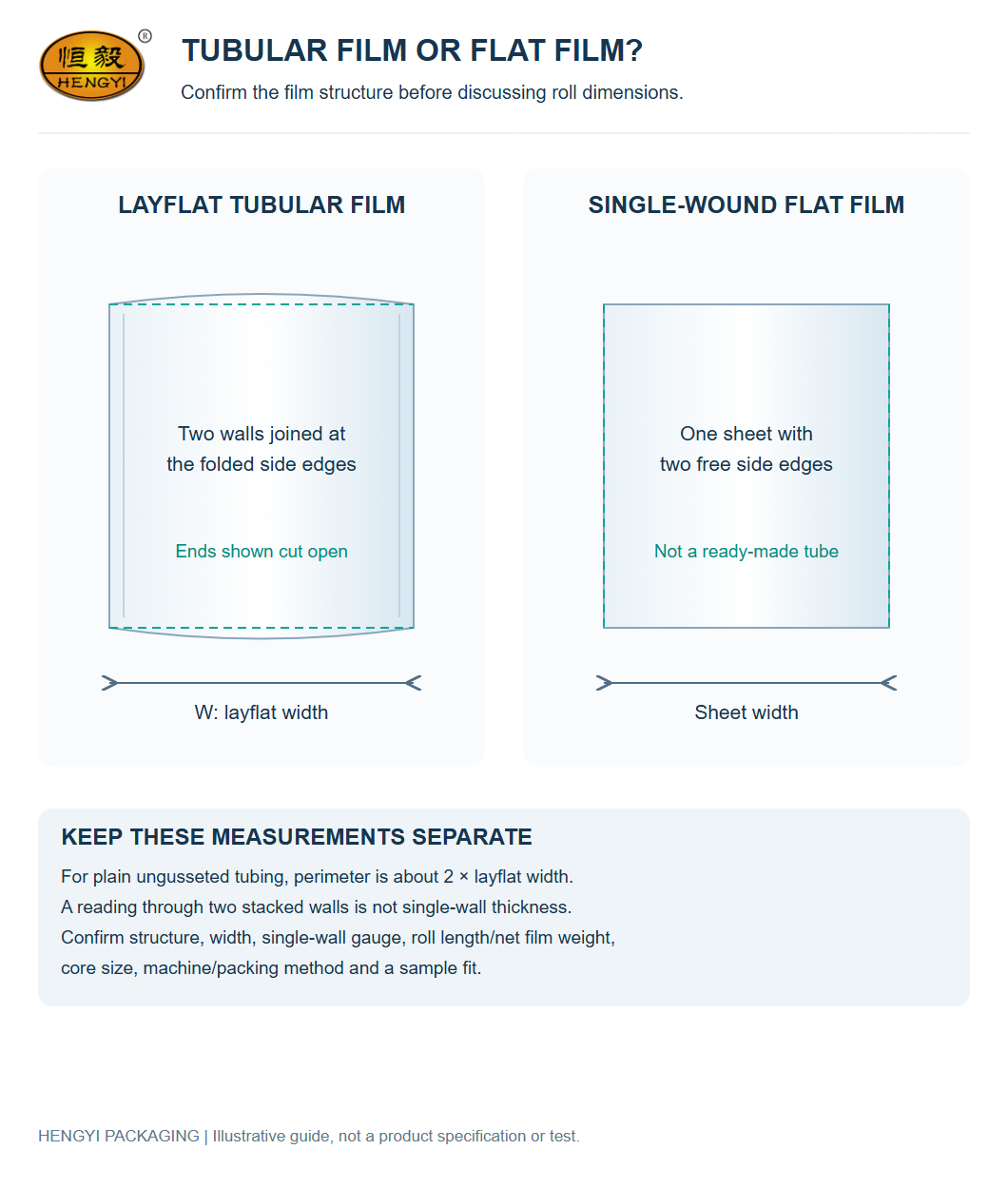
Structure illustration, not a photograph, stocked specification or performance test. The tubing example is plain and ungusseted. Click to enlarge.
Measure plain tubing across its width when laid flat without stretching. That measurement is not its opened diameter. For a plain ungusseted tube, its perimeter is approximately twice the layflat width. This geometric relationship is a starting point for discussing size, rather than a finished fit recommendation.
The required allowance depends on the item's full profile, joints or protrusions, protective layers and the insertion method. A soft, thin film may behave differently from a stiffer film during packing. Send the maximum packed cross-section and trial the sample over the actual item. Do not use a diameter-only calculation to guarantee insertion or handling performance.
A gauge reading through both flattened walls is a stack measurement. Specify the required single-wall thickness and unit separately. If measurements are taken through two layers, identify them as two-layer readings and agree how they are checked. Folds, overlap, compression and instrument use can affect the result.
Thickness by itself does not establish puncture resistance, load capacity, heat-seal strength or suitability for a particular environment. Provide handling conditions and sharp-edge risks, then agree the material, sample and relevant checks. Special requirements such as antistatic or UV performance need their own review.
Alongside structure, width and gauge, state roll length or net film weight, the core dimensions and any maximum outside diameter required by the equipment. Net film weight excludes the core and outer packing. A gross roll weight should be labelled accordingly. These distinctions help prevent a quotation for one roll construction being compared with a different one.
For printed film, include artwork, colours, print repeat, registration needs and winding direction. Confirm the film path on the actual machine. The applicable quantity, unit of sale, printing costs and delivery schedule belong in the agreed quotation; no universal roll weight, core size or lead time is implied by this guide.
No. Confirm the film structure and intended process. A product described as industrial tubing should not be selected solely because a search result also uses pallet-wrapping keywords.
Not reliably. Request the opening view, structure drawing or sample when the walls and folded edges are not visible.
No. Material suitability and supporting documents must be reviewed for the actual application, contact conditions and destination requirements.
Send the packing method and item drawing, the required film structure, layflat or sheet width, single-wall thickness, roll length or net film weight, core details, artwork and quantity. Mark uncertain dimensions for review rather than treating them as final.
Hangzhou Hengyi Packaging Material Co., Ltd. reviews PE packaging requests against the intended application and agreed roll construction. Explore the industrial PE tubing product and PE film roll range. For the next details, read the film roll buying guide and single-side versus total thickness guide, or send your specification for review.
