


Phone:
+86-13456733297


Views: 0 Author: Hengyi Packaging Publish Time: 2026-11-02 Origin: Hangzhou Hengyi Packaging Material Co., Ltd.


Specify a die-cut handle shopping bag with the body width, total body height and a clearly defined gusset dimension. Then state the usable height below the hand hole, single-side thickness and intended contents. A dimension such as “30 × 38 + 10 cm” is incomplete until both parties agree what each number measures.
A die-cut handle is an opening cut through the bag body. It is different from a separate soft loop attached above the bag. The distinction matters when comparing overall height: a loop can extend beyond the body, while a die-cut opening occupies part of the body itself. A size copied from a loop-handle drawing should therefore not be assumed to give the same usable internal height in a die-cut bag.
Images may show a folded-over top, a patch or a textured region around the hand hole. Those features can help identify questions to ask, but a surface texture alone does not establish a specific reinforcement process or tested carrying strength. Confirm the construction on the drawing or sample rather than naming it from a photograph.
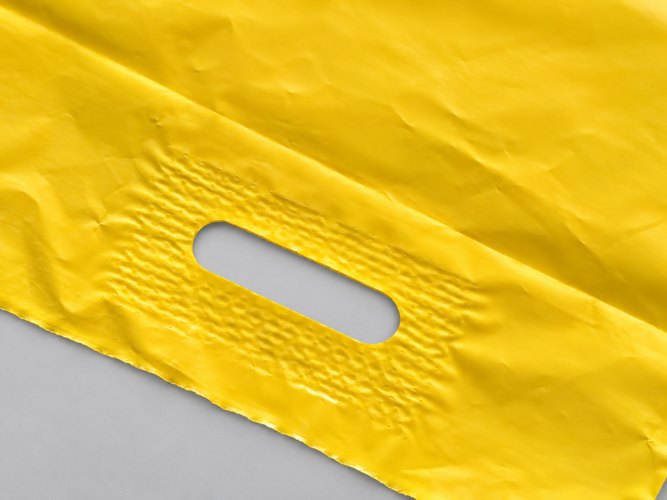
Retouched product-detail illustration. Confirm the actual handle construction and usable clearance on the sample; this picture is not a load test.
Measurement | How to describe it | Common source of confusion |
|---|---|---|
W: body width | State the finished front-face width. | Confusing the face width with an opened gusset dimension. |
H: body height | State the top body edge to the bottom edge, and separately the usable height. | Including or excluding a separate handle on another bag type. |
G: bottom gusset | State the full unfolded bottom depth, if that is the agreed convention. | Quoting one folded half as if it were the entire depth. |
Single-side thickness | Give the thickness of one wall in microns or mm. | Giving the combined reading of two walls. |
Handle clearance | Give the usable distance below the hand hole. | Assuming all of H is available for contents. |
A bottom gusset opens at the base. A side gusset opens along a side. They affect the packed shape differently, so the word “gusset” on its own is not sufficient for a quotation. Draw where the fold sits and show whether the quoted dimension is a folded inset or the full opened depth. Do not infer a side gusset simply because an angled photograph shows a narrow side surface.
The A4 comparison uses front-face width and height. The “+ G” reference describes an additional structural dimension, not extra paper-sized area available above or beside the A4 rectangle. Final packing clearance also depends on seal position, folds and the thickness of the contents.
A thin garment, a boxed gift and a stack of catalogues may fit the same outside bag dimensions but place different stresses on the handle and bottom. Provide the packed item dimensions, weight, corners and intended use. Avoid selecting thickness by appearance alone: coloured film and lighting can make a photograph look thicker or more opaque than the confirmed material.
At Hengyi, the custom packaging discussion should connect those details with material, single-side thickness, bag structure and printing. Hangzhou Hengyi Packaging Material Co., Ltd. uses gravure printing for its custom printed packaging work. The required artwork, sides and colours must be reviewed for the particular specification; the photograph is not a substitute for a print proof.
Can the item enter the opening without forcing the hand hole?
Does the filled bag sit and carry as intended?
Is the opening shape and distance from the top edge clear?
Are the bottom folds and seals in the agreed positions?
Does the approved material and thickness suit the actual contents?
No single convention should be assumed. State the folded or fully opened measurement explicitly and confirm it on a drawing.
No. Construction and performance are different questions. Agree the actual load and testing conditions for the finished sample.
Explore Hengyi custom die-cut handle shopping bags or discuss your packaging specification.
